
SURFEX® — a leading shot peening machine manufacturer in India, engineering precision shot peening machines trusted by industries across India and worldwide since 1977.
Request a Technical Quote View Machine Range
47+ years of surface-engineering experience behind every air-operated and airless shot peening system we build.
Repeatable, Almen-verified coverage for gears, shafts, springs and aerospace-grade geometries.
Two proven technologies, one manufacturer — choose nozzle-driven precision or turbine-driven volume.
Transparent, specification-led quotes from an engineering team that designs, not just assembles.
CE-marked systems engineered in India and exported to customers across the Middle East, Africa, Europe and Southeast Asia.
Almen-verified, SAE/AMS-compliant equipment built for international quality audits, not just domestic orders.
Documented quality management and CE compliance that international buyers can verify before they order.
SURFEX® is one of the leading shot peening machine manufacturers in India, with more than 47+ years of surface-engineering experience since 1977. We design, engineer and manufacture precision shot peening machines — including air-operated (nozzle-operated), airless (turbine-operated), CNC, and robotic systems — used to induce compressive residual stress and improve the fatigue life, durability and load-bearing performance of critical metal components such as gears, shafts, springs and aerospace structures.
As a trusted shot peening machine manufacturer, every SURFEX® system is built to ISO 9001:2015, ISO 14001:2015 and CE certification standards, with process intensity verified through Almen strip testing to SAE and AMS specifications. Our shot peening machine range serves the aerospace, automotive, railway, oil & gas, power generation and heavy engineering industries — supplied to customers across India and international markets — which is why engineering teams consistently rank SURFEX® among the most reliable shot peening machine manufacturers in India and worldwide.
As a shot peening machine manufacturer, SURFEX® treats every quotation as an engineering brief, not a catalogue order. Since 1977, our design office has worked directly with fatigue-critical component makers to correct the two failure points that plague poorly built peening equipment: inconsistent Almen intensity and uneven coverage on complex geometry.
Most buyers searching for a shot peening machine manufacturer arrive already knowing they need compressive residual stress on a spring, gear or aerostructure — what they are really evaluating is whether the manufacturer can hold that intensity number, batch after batch, for years. That is a controls and fixture-design problem as much as a fabrication one, and it is the reason our engineering team gets involved before the first steel plate is cut, not after.
Because we are also one of the established shot blasting machine manufacturers in India, our shot peening machines share the same cabinet engineering, dust-recovery discipline and controls architecture that our surface-cleaning lines are known for — built on one factory floor in Jodhpur, tested to one quality standard, and backed by one after-sales team. If you are comparing shot peening machine manufacturers in India on more than price alone, this is the difference our clients mention first: a manufacturer that understands metallurgy, not just fabrication.
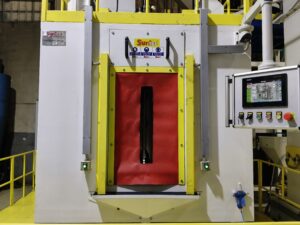
Shot peening is a controlled cold-working process in which small, round media are propelled at a metal surface to induce residual compressive stress beneath it — a stress layer that actively resists fatigue cracking, not merely a cosmetic finish.
Every shot peening machine we build exists to make that stress layer repeatable, batch after batch. Round media strikes the surface at a calculated velocity and angle; each impact leaves a shallow dimple and pushes a compressive stress zone just below it. Stack thousands of these dimples uniformly across a spring, gear tooth or turbine blade root, and the part resists crack initiation far longer under cyclic load than an unpeened equivalent.
Want the deeper technical breakdown — media selection, coverage percentage, saturation curves? Read our detailed engineering guide: What Is Shot Peening?
| Parameter | Shot Peening | Shot Blasting |
|---|---|---|
| Primary Objective | Induce compressive residual stress to raise fatigue life | Clean, descale or profile a surface before coating |
| Media Geometry | Round, spherical (steel, cut wire, glass, ceramic) | Angular grit or aggressive steel grit/shot |
| Process Control | Almen strip & saturation curve, SAE/AMS governed | Visual coverage, less intensity-critical |
| Typical Parts | Springs, gears, shafts, aerospace structures | Castings, structural steel, fabrications |
| Failure Mode Addressed | Fatigue cracking, stress corrosion | Rust, scale, old coatings, weld spatter |
A shot peening machine is only as good as its ability to prove what it did. We calibrate every unit around Almen strip testing so that intensity is a documented, auditable number — not an operator’s guess.
Media type, pressure/turbine RPM and exposure time are fixed for the component geometry.
Standard spring-steel strips are peened alongside real parts inside the machine.
Strip curvature is measured on an Almen gauge to plot the saturation curve.
Parameters are frozen against SAE/AMS limits and logged for every production batch.
Choosing between nozzle-driven and turbine-driven equipment usually comes down to component geometry and production volume — both are engineered and built in-house, so the recommendation you get is technical, not sales-driven.
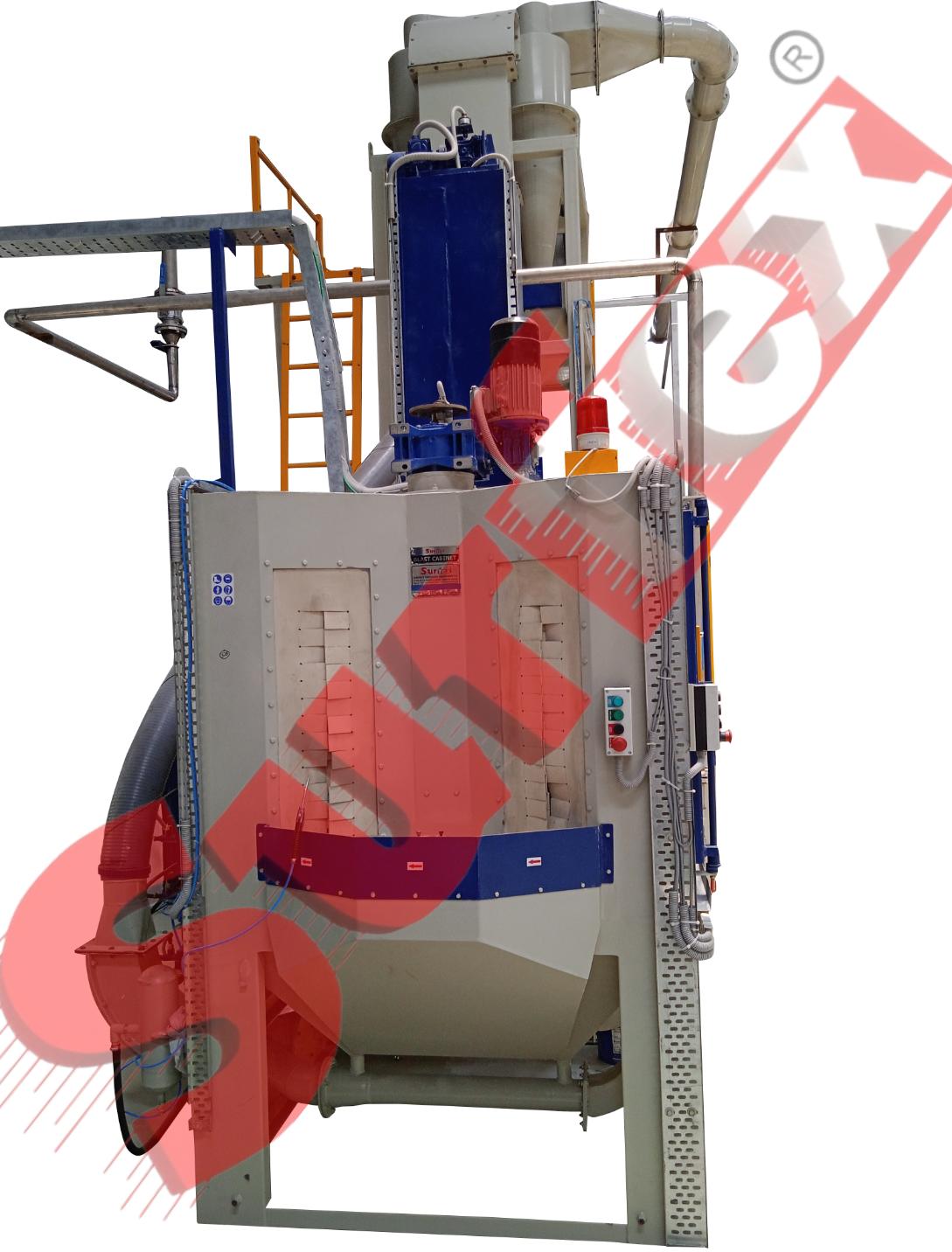
Compressed-air nozzles give fine, adjustable control over intensity — the preferred choice for complex geometries, low-to-medium volume, and jobs demanding tight Almen tolerance.
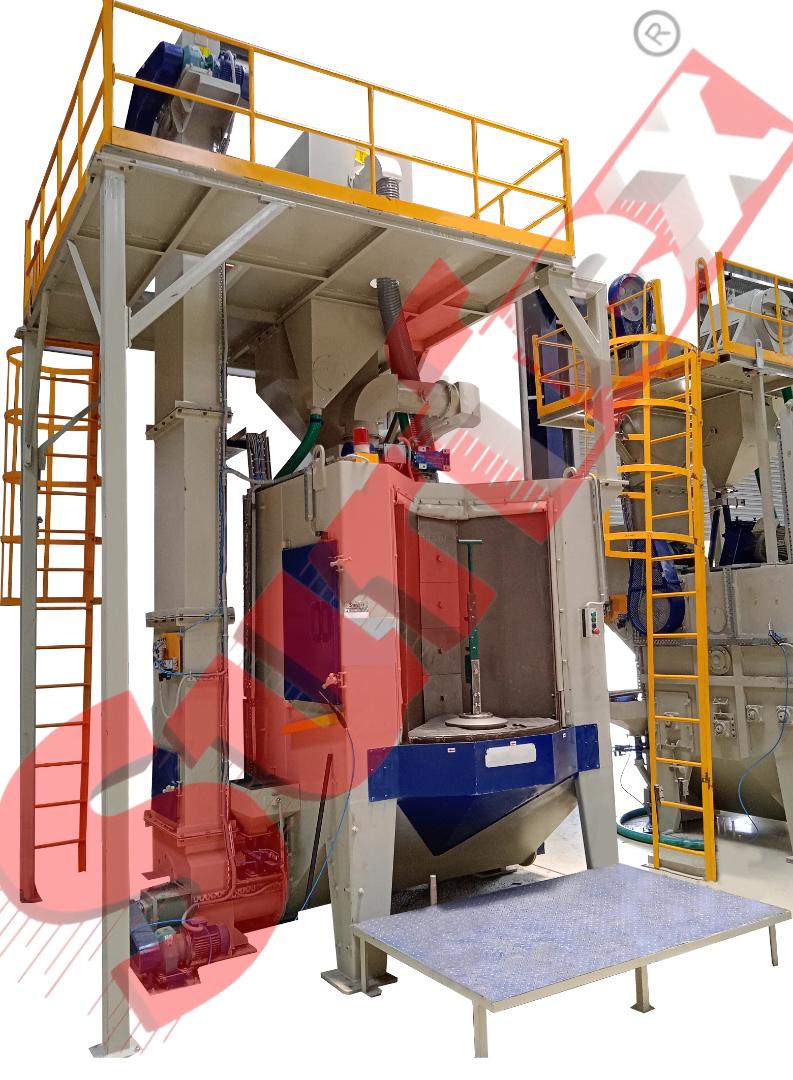
High-throughput turbine wheels move large media volumes at speed, built for continuous, high-volume production peening where cycle time drives the return on a shot peening machine price.
| Quick Selection Guide | Air-Operated (Nozzle) | Airless (Turbine) |
|---|---|---|
| Intensity Control | Fine, adjustable by air pressure | Set by turbine RPM & media flow |
| Best For | Complex geometry, tight Almen tolerance | High-volume continuous production |
| Volume | Low to medium | Medium to high |
| Typical Parts | Gears, aerospace parts, small batches | Springs, bulk automotive components |
Peening quality is decided by the details inside the cabinet. These are the subsystems we engineer around, configured to your component, volume and automation level.
Wear-protected chambers, hardened tooling and accessible maintenance points support multi-shift production with less downtime.
Design, fabrication, wiring and Almen-verified trials happen on one factory floor in Jodhpur, so quality is controlled end to end.
Easy load/unload fixtures and layouts that are ready for robot or gantry loading as your production grows.
Whether it is an air-operated or an airless shot peening machine, every cycle follows the same closed loop — media is accelerated, strikes the component, and is recovered, cleaned and reused.
The part is mounted on the indexing table, spindle or fixture inside the sealed peening chamber, positioned for the required coverage.
Air-operated machines propel shot through nozzles with compressed air; airless machines throw it from a high-speed turbine wheel.
The part rotates, indexes or is manipulated by CNC axes or a robot so every critical surface receives uniform, controlled impact.
Used shot falls to the hopper and is lifted back to the storage bin by a screw conveyor or bucket elevator.
An air-wash separator removes broken media and dust; only good, round shot returns to the cycle while the dust collector keeps the chamber clean.
Almen strips and coverage checks confirm intensity, and parameters are logged against SAE/AMS limits for traceability.
The result is controlled by a handful of parameters: shot type and size, shot velocity (air pressure or turbine RPM), media flow rate, exposure time, and part movement. Set correctly for the component geometry, they deliver the Almen intensity and coverage your specification demands, cycle after cycle.
A quick view of every standard shot peening machine in the SURFEX® range, with where each one fits best.
| Machine Type | Operation | Best For |
|---|---|---|
| Indexing Table Type (Air-Operated / Airless) | Nozzle or turbine peening on an indexing table | Batch peening of small to medium components |
| CNC Shot Peening Machine | Programmable multi-axis nozzle motion | Gears, shafts, transmission parts |
| Robotic Shot Peening — Aerospace | Multi-axis robot manipulation | Turbine and structural aerospace parts |
| Robotic Shot Peening — Automotive | Automated cell with production-line cycle | High-volume automotive components |
| Oil & Gas Shot Peening Machine | Heavy-duty large-chamber peening | Drilling and downhole components |
| Coil & Leaf Spring Shot Peening Machine | Dedicated continuous spring line | Suspension springs for automotive and rail |
| Tumblast Type Shot Peening Machine | Rubber-belt conveyor tumbling | Bulk small and medium parts |
| Component / Requirement | Recommended Machine | Why It Suits |
|---|---|---|
| Gears, shafts and transmission parts | CNC Shot Peening Machine | Programmed axis motion gives repeatable root and flank coverage. |
| Complex aerospace geometry | Robotic Shot Peening — Aerospace | Multi-axis manipulation reaches difficult surfaces with documented repeatability. |
| High-volume automotive lines | Robotic Shot Peening — Automotive | Automated cell built for production throughput and uptime. |
| Coil and leaf springs | Spring Shot Peening Machine | Dedicated line for consistent peening of suspension springs. |
| Large, heavy forgings and drilling parts | Oil & Gas Shot Peening Machine | Heavy-duty chamber handles big, awkward components. |
| Bulk small and medium components | Tumblast Type Shot Peening Machine | Rubber-belt tumbling treats many parts per batch. |
| Tight Almen tolerance, low to medium volume | Air-Operated (Nozzle) Machine | Fine control of intensity through air pressure. |
| Continuous high-volume production | Airless (Turbine) Machine | High media throughput lowers cost per part. |
Need help selecting? The right machine depends on more than type: component dimensions and weight, material, geometry, required Almen intensity and coverage, shot media, production quantity, cycle time and floor space. Share these on the RFQ form and our engineers will recommend a configuration. Get Expert Advice →
As a full-line shot peening machine manufacturer, SURFEX® builds equipment around the component, the industry and the automation level you need — from manual air-operated cabinets to fully robotic peening cells.
Programmable axis control for consistent root and flank coverage on transmission components.
Multi-axis robotic manipulation for aerospace-grade repeatability on turbine and structural parts.
Automated peening cells engineered for automotive production-line throughput and uptime.
Heavy-duty systems built for pressure-critical drilling and downhole equipment.
Dedicated spring-peening lines for automotive and rail suspension manufacturing.
Rubber-belt conveyor design for bulk peening of small and medium components.
A shot peening machine that cannot prove compliance is a liability on an aerospace or automotive supplier audit. Every SURFEX® system is engineered so your process team can demonstrate traceability against the standards auditors actually check for:
Almen strip, holder and gauge specifications built into our test-strip fixtures as standard.
Aerospace peening intensity and media-quality references our robotic and CNC cells are configured to meet.
Quality management covering design, fabrication and final inspection of every machine we ship.
Environmental management and CE-marked build quality for machines exported into regulated markets.
This is also why buyers comparing shot peening machine manufacturers in India often shortlist SURFEX® first: the paperwork behind the machine is as engineered as the machine itself, which matters the moment your customer’s quality team asks for evidence. View certifications →
Our shot peening equipment strengthens and extends the fatigue life of a wide range of metal parts, from transmission gears to turbine blades.
External and internal gears and gear shafts: peening the tooth root raises bending-fatigue strength for high-torque transmissions.
Crankshafts, camshafts, drive shafts and large shafts that carry cyclic and torsional loads.
Connecting rods and other engine components that see millions of load cycles.
Blade roots, landing-gear parts and structural airframe components needing documented, even coverage.
Coil and leaf springs for automotive and rail, peened on dedicated high-throughput lines.
Drilling and downhole components, where fatigue and stress corrosion cracking are costly.
Electric-vehicle gearboxes run at high speed and torque, so tooth-root bending fatigue becomes a design limit. A CNC or robotic shot peening cell delivers repeatable root and flank coverage at production cycle times, with Almen-verified intensity logged for every batch, whether the gear sits in an EV drivetrain, a hybrid or a conventional transmission.
Media choice changes the Almen result as much as machine settings do, so every shot peening machine we build is set up and validated for the exact media your specification calls for.
Fatigue-critical components across nine major sectors run on SURFEX® shot peening equipment, from aerospace landing gear to wind-turbine gear sets. Each sector pushes the machine specification in a different direction: aerospace demands robotic repeatability and full Almen documentation per part number; automotive spring and gear lines demand cycle time and 24×7 uptime; oil & gas components demand heavy-duty chambers that can handle large, awkward forgings without sacrificing coverage.
Railway axle and bogie components, medical implant substrates, and power-generation turbine and compressor parts round out the remaining sectors we regularly quote for — most of them entering the conversation because a fatigue failure elsewhere in their industry made compressive residual stress a specification line item rather than an afterthought.
Procurement teams shortlisting shot peening machine manufacturers usually run the same four checks — how long has the company built this specific equipment, does the team understand the metallurgy behind it, can they prove certification, and will support still be there in year six. Here is how that plays out with SURFEX®.
Manufacturing surface-treatment equipment in Jodhpur since 1977, across generations of blasting and peening technology.
Machines specified around Almen saturation curves and SAE/AMS limits, not generic blast-cabinet templates.
ISO 9001:2015, ISO 14001:2015 & CE-marked production, exporting to international markets.
Operator training, annual maintenance contracts and a genuine spare-parts inventory on every machine sold.
There is no single shot peening machine price because no two production lines peen the same part the same way. Four variables move the number more than any brochure figure: whether the system is air-operated or airless, the level of automation (manual, CNC or robotic), chamber size against your largest component, and the media-recovery and dust-collection specification required for your shop floor. A compact air-operated cabinet for low-volume spring peening and a fully robotic aerospace peening cell sit at opposite ends of that scale — which is why we quote against your drawing and cycle-time target rather than a price list.
It is worth budgeting for total cost of ownership rather than sticker price alone. Media consumption, nozzle or turbine-blade wear life, dust-collector filter replacement, and the availability of genuine spare parts all affect what a shot peening machine actually costs across a five- to ten-year working life. A lower upfront quote from an unfamiliar fabricator can end up more expensive once downtime and imported spare-part lead times are factored in — one more reason established shot peening machine manufacturers with an in-country spares stock tend to win repeat business rather than one-off orders.
From a gear shop in Pune to an aerospace supplier in Europe, the machine is designed around one thing: holding your Almen intensity, batch after batch.
Automotive, forging, gear, spring, railway and heavy-engineering plants get a machine proposed around their own drawing, with trials on sample parts, commissioning at site, operator training and spares support from our Jodhpur factory.
Aerospace, energy and automotive suppliers abroad receive CE-marked machines with Almen documentation, English manuals, utilities configured for the destination market, export crating and containerised dispatch.
Multi-station, CNC and robotic cells designed for line integration, with process parameters logged per batch so your own customer audits run smoothly.
Buying a shot peening machine is a specification exercise, not a shopping-cart transaction. Every project moves through the same six disciplined stages, from first drawing to first production shift.
We review your drawing, material, hardness and fatigue requirement, and agree the Almen intensity and coverage your specification demands.
Air-operated or airless, media type, nozzle or turbine layout and automation level are selected, with sample parts trial-peened in-house where required.
General arrangement, fixture design, utilities and layout are shared for your sign-off before any steel is cut.
The machine is fabricated, wired and run through Almen-verified trials on our own floor before it leaves Jodhpur.
Machines are crated and containerised for sea or road dispatch, with manuals and documentation packed to match.
Installation, operator training, a documented maintenance schedule and genuine spares keep the machine production-ready for years.
Our factory sits in Jodhpur’s M.I.A. industrial belt, one of India’s established hubs for surface-preparation and finishing machinery. Skilled fabrication labour and fast logistics are on the doorstep, which means shorter build cycles, tighter quality control and a shot peening machine price that stays competitive without compromising the discipline ISO 9001 and CE demand.
The same Almen-verified process control and documentation travel with every machine, whether it is installed in an automotive cluster in India or an aerospace supplier’s facility overseas. Export crating and containerised dispatch are routine for us, which is why buyers searching for shot peening machine manufacturers in India increasingly come from well beyond India.
Almen strip data, SAE J442 / J443 test practice and AMS 2430 references documented for your quality team.
CE-marked build, with documentation planned around Machinery Regulation (EU) 2023/1230, which replaces Directive 2006/42/EC from 20 January 2027.
Voltage, frequency, compressed-air and dust-extraction requirements matched to your plant and country.
Export crating, containerised dispatch and remote commissioning guidance ahead of on-site handover.
Sales and technical support:
Markets we build for: Middle East (UAE, Saudi Arabia, Oman) · Africa (South Africa, Nigeria) · Europe (United Kingdom, Germany) · Southeast Asia (Vietnam, Indonesia) · United States · Australia
E-100, M.I.A., Phase-II Basni,
Jodhpur – 342005, Rajasthan, India
Call our engineering desk directly:
A properly specified shot peening machine turns surface stress into a design advantage across fatigue, corrosion and wear.
Compressive residual stress delays crack initiation, so gears, springs and shafts survive far more load cycles.
Surface tension is converted to compression, which helps parts resist stress corrosion cracking in harsh service.
Cold working slightly hardens the surface layer, supporting resistance to abrasion and fretting.
Higher fatigue strength lets engineers reduce section thickness or raise working loads on the same part.
Fewer premature failures and replacements mean less downtime and lower maintenance spend.
Almen-verified, logged batches give your customers the evidence aerospace and automotive audits ask for.
Use these six checks when you compare shot peening machine manufacturers.
Ask how long the company has built peening equipment, not just general fabrication.
Look for Almen, saturation-curve and SAE/AMS understanding, not only cabinet building.
The machine should fit your part, volume and automation level, not the other way round.
ISO 9001, ISO 14001 and CE should be documented and checkable.
Wear-resistant liners, robust media handling and reliable controls decide long-term uptime.
Training, maintenance contracts and in-country spares matter more in year six than in year one.
Shot that is too hard, too soft or the wrong size gives poor stress depth or surface damage. Match media to material and specification.
Missed areas stay vulnerable to fatigue. Critical parts need full, verified coverage, not an operator’s estimate.
Too low gives little benefit; too high causes distortion. Calibrate with Almen strips and recheck regularly.
Worn nozzles, turbine blades and liners change the shot stream and quietly shift your intensity.
Broken shot and dust in the working mix hurt consistency. Keep the separator and dust collector in good order.
Process changes without the machine builder’s input often cause avoidable quality and safety issues.
Check shot flow, air pressure or turbine speed, and nozzle distance and angle against your qualified settings.
Peen strips with the parts and log the arc height so every lot is traceable.
Inspect wear parts, lubricate, clean dust-collector filters and test electrical and pneumatic systems on a schedule.
Trained operators spot drift early and hold parameters steady across shifts.
Keep nozzles, turbine blades and wear liners ready so a small fault never stops production.
A shot peening machine is surface-strengthening equipment that fires round media — steel, glass or ceramic shot — at a metal component under controlled velocity. Each impact induces a small compressive stress zone beneath the surface, which delays crack initiation and extends the component’s fatigue life under repeated loading.
SURFEX® (Surface Finishing Equipment Company) is among the established shot peening machine manufacturers in India, building air-operated, airless, CNC and robotic peening systems since 1977 for aerospace, automotive, spring and heavy-engineering manufacturers.
Shot blasting cleans, descales or profiles a surface using sharp, angular media. Shot peening uses round, spherical media under Almen-controlled intensity purely to strengthen the metal by inducing compressive residual stress — it is a metallurgical process, not a cleaning one.
Price depends on machine type (air-operated, airless, CNC or robotic), chamber size, media-recovery specification and automation level. Standard manual configurations are the most economical; CNC and robotic systems are quoted against your component drawing and target cycle time.
Aerospace (landing gear, turbine blades), automotive (springs, gears, crankshafts, connecting rods) and heavy engineering (oil & gas equipment, railway components, power-generation gearing) are the biggest users, wherever parts face high-cycle fatigue loading.
Intensity is measured using Almen strips and an Almen gauge. Standard spring-steel strips are peened alongside the actual components; the resulting arc height is plotted on a saturation curve to confirm the process meets SAE or AMS specification limits.
Yes. CNC-controlled shot peening machines suit gears and shafts needing programmed axis coverage, while robotic shot peening cells handle complex aerospace and automotive geometries that demand repeatable, multi-angle exposure.
Cast steel shot suits heavy steel and iron components; conditioned cut wire shot gives uniform, aerospace-grade results; glass beads avoid iron contamination on non-ferrous parts; and ceramic beads deliver a fine finish on hard metals.
Standard air-operated or airless cabinets are typically installed and commissioned within a few days of arrival once utilities (compressed air, power, dust extraction) are ready. CNC and robotic peening cells take longer, since programming and Almen-verification trials are run on-site against your actual component drawings before production sign-off.
SURFEX® backs every shot peening machine with operator training at handover, scheduled annual maintenance visits, and a genuine spare-parts inventory for nozzles, turbine blades, control components and wear liners — support delivered from India rather than routed through an overseas distributor.
Send us your component drawing and fatigue requirement — our engineering desk will recommend air-operated, airless, CNC or robotic, with a specification-backed quote.
Submit RFQContact UsView Shot Blasting Range