
SURFEX® is one of the leading shot peening machine manufacturers in India, with more than 47+ years of surface-engineering experience since 1977. We design, engineer and manufacture precision shot peening machines — including air-operated (nozzle-operated), airless (turbine-operated), CNC, and robotic systems — used to induce compressive residual stress and improve the fatigue life, durability and load-bearing performance of critical metal components such as gears, shafts, springs and aerospace structures.
As a trusted shot peening machine manufacturer, every SURFEX® system is built to ISO 9001:2015, ISO 14001:2015 and CE certification standards, with process intensity verified through Almen strip testing to SAE and AMS specifications. Our shot peening machine range serves the aerospace, automotive, railway, oil & gas, power generation and heavy engineering industries — supplied to customers across India and international markets — which is why engineering teams consistently rank SURFEX® among the most reliable shot peening machine manufacturers in India and worldwide.
As a shot peening machine manufacturer, SURFEX® treats every quotation as an engineering brief, not a catalogue order. Since 1977, our design office has worked directly with fatigue-critical component makers to correct the two failure points that plague poorly built peening equipment: inconsistent Almen intensity and uneven coverage on complex geometry.
Most buyers searching for a shot peening machine manufacturer arrive already knowing they need compressive residual stress on a spring, gear or aerostructure — what they are really evaluating is whether the manufacturer can hold that intensity number, batch after batch, for years. That is a controls and fixture-design problem as much as a fabrication one, and it is the reason our engineering team gets involved before the first steel plate is cut, not after.
Because we are also one of the established shot blasting machine manufacturers in India, our shot peening machines share the same cabinet engineering, dust-recovery discipline and controls architecture that our surface-cleaning lines are known for — built on one factory floor in Jodhpur, tested to one quality standard, and backed by one after-sales team. If you are comparing shot peening machine manufacturers in India on more than price alone, this is the difference our clients mention first: a manufacturer that understands metallurgy, not just fabrication.
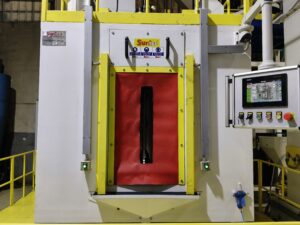
Shot peening is a controlled cold-working process in which small, round media are propelled at a metal surface to induce residual compressive stress beneath it — a stress layer that actively resists fatigue cracking, not merely a cosmetic finish.
Every shot peening machine we build exists to make that stress layer repeatable, batch after batch. Round media strikes the surface at a calculated velocity and angle; each impact leaves a shallow dimple and pushes a compressive stress zone just below it. Stack thousands of these dimples uniformly across a spring, gear tooth or turbine blade root, and the part resists crack initiation far longer under cyclic load than an unpeened equivalent.
Want the deeper technical breakdown — media selection, coverage percentage, saturation curves? Read our detailed engineering guide: What Is Shot Peening?
| Parameter | Shot Peening | Shot Blasting |
|---|---|---|
| Primary Objective | Induce compressive residual stress to raise fatigue life | Clean, descale or profile a surface before coating |
| Media Geometry | Round, spherical (steel, cut wire, glass, ceramic) | Angular grit or aggressive steel grit/shot |
| Process Control | Almen strip & saturation curve, SAE/AMS governed | Visual coverage, less intensity-critical |
| Typical Parts | Springs, gears, shafts, aerospace structures | Castings, structural steel, fabrications |
| Failure Mode Addressed | Fatigue cracking, stress corrosion | Rust, scale, old coatings, weld spatter |
A shot peening machine is only as good as its ability to prove what it did. We calibrate every unit around Almen strip testing so that intensity is a documented, auditable number — not an operator's guess.
Media type, pressure/turbine RPM and exposure time are fixed for the component geometry.
Standard spring-steel strips are peened alongside real parts inside the machine.
Strip curvature is measured on an Almen gauge to plot the saturation curve.
Parameters are frozen against SAE/AMS limits and logged for every production batch.
Choosing between nozzle-driven and turbine-driven equipment usually comes down to component geometry and production volume — both are engineered and built in-house, so the recommendation you get is technical, not sales-driven.
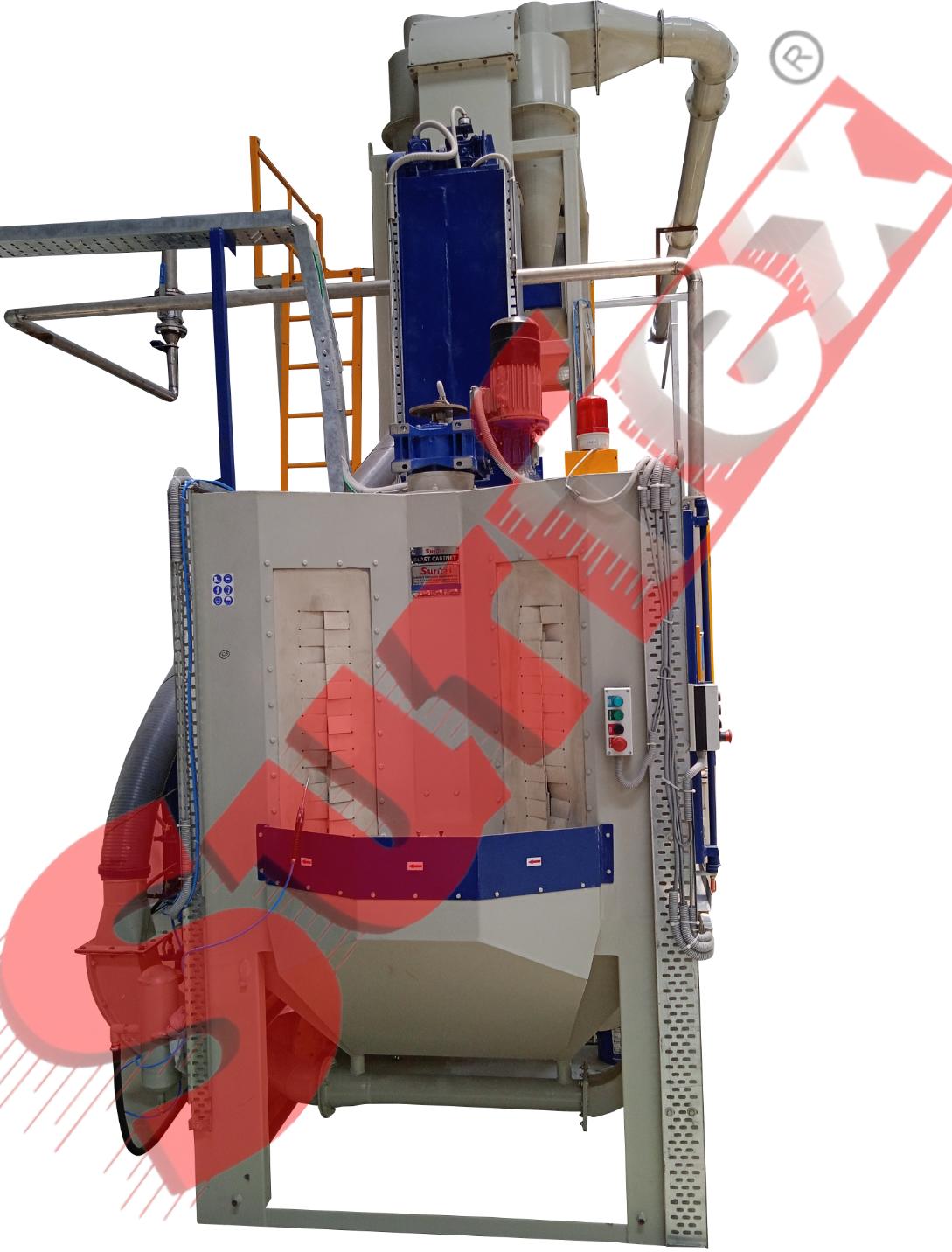
Compressed-air nozzles give fine, adjustable control over intensity — the preferred choice for complex geometries, low-to-medium volume, and jobs demanding tight Almen tolerance.
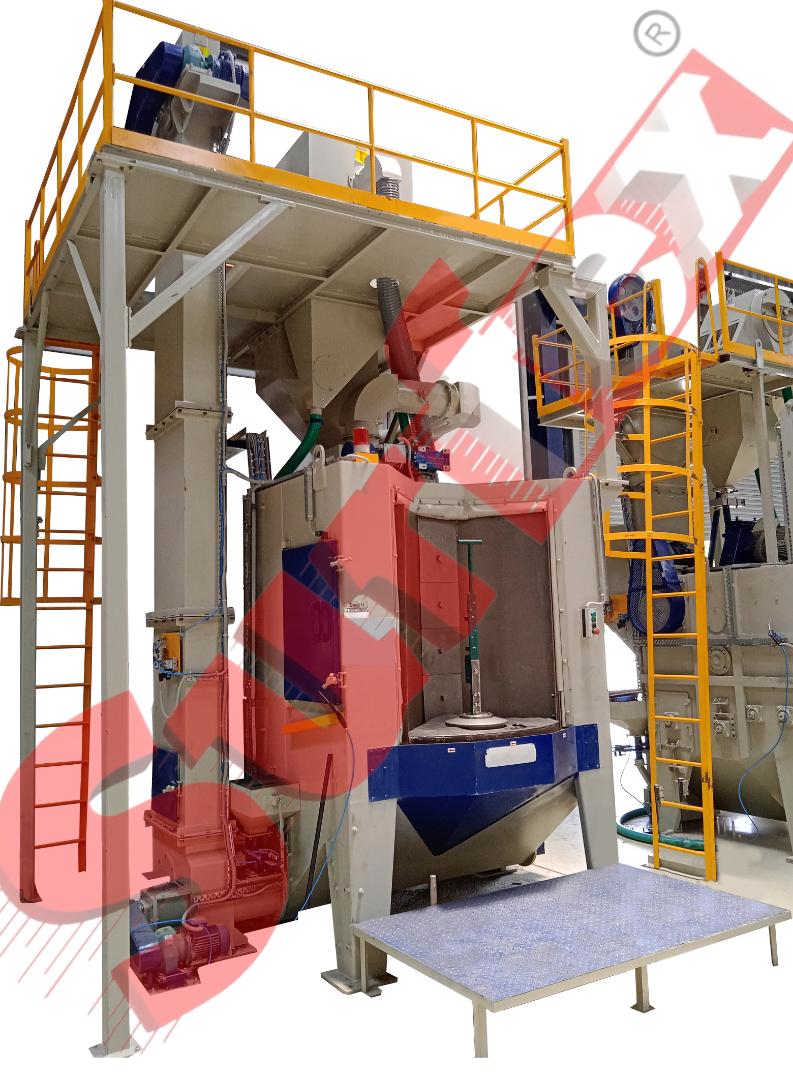
High-throughput turbine wheels move large media volumes at speed, built for continuous, high-volume production peening where cycle time drives the return on a shot peening machine price.
As a full-line shot peening machine manufacturer, SURFEX® builds equipment around the component, the industry and the automation level you need — from manual air-operated cabinets to fully robotic peening cells.
Programmable axis control for consistent root and flank coverage on transmission components.
View MachineMulti-axis robotic manipulation for aerospace-grade repeatability on turbine and structural parts.
View MachineAutomated peening cells engineered for automotive production-line throughput and uptime.
View MachineHeavy-duty systems built for pressure-critical drilling and downhole equipment.
View MachineDedicated spring-peening lines for automotive and rail suspension manufacturing.
View MachineRubber-belt conveyor design for bulk peening of small and medium components.
View MachineA shot peening machine that cannot prove compliance is a liability on an aerospace or automotive supplier audit. Every SURFEX® system is engineered so your process team can demonstrate traceability against the standards auditors actually check for:
Almen strip, holder and gauge specifications built into our test-strip fixtures as standard.
Aerospace peening intensity and media-quality references our robotic and CNC cells are configured to meet.
Quality management covering design, fabrication and final inspection of every machine we ship.
Environmental management and CE-marked build quality for machines exported into regulated markets.
This is also why buyers comparing shot peening machine manufacturers in India often shortlist SURFEX® first: the paperwork behind the machine is as engineered as the machine itself, which matters the moment your customer's quality team asks for evidence.
Media choice changes the Almen result as much as machine settings do, so every shot peening machine we build is set up and validated for the exact media your specification calls for.
Fatigue-critical components across nine major sectors run on SURFEX® shot peening equipment, from aerospace landing gear to wind-turbine gear sets. Each sector pushes the machine specification in a different direction: aerospace demands robotic repeatability and full Almen documentation per part number; automotive spring and gear lines demand cycle time and 24×7 uptime; oil & gas components demand heavy-duty chambers that can handle large, awkward forgings without sacrificing coverage.
Railway axle and bogie components, medical implant substrates, and power-generation turbine and compressor parts round out the remaining sectors we regularly quote for — most of them entering the conversation because a fatigue failure elsewhere in their industry made compressive residual stress a specification line item rather than an afterthought.
Procurement teams shortlisting shot peening machine manufacturers usually run the same four checks — how long has the company built this specific equipment, does the team understand the metallurgy behind it, can they prove certification, and will support still be there in year six. Here is how that plays out with SURFEX®.
Manufacturing surface-treatment equipment in Jodhpur since 1977, across generations of blasting and peening technology.
Machines specified around Almen saturation curves and SAE/AMS limits, not generic blast-cabinet templates.
ISO 9001:2015, ISO 14001:2015 & CE-marked production, exporting to international markets.
Operator training, annual maintenance contracts and a genuine spare-parts inventory on every machine sold.
There is no single shot peening machine price because no two production lines peen the same part the same way. Four variables move the number more than any brochure figure: whether the system is air-operated or airless, the level of automation (manual, CNC or robotic), chamber size against your largest component, and the media-recovery and dust-collection specification required for your shop floor. A compact air-operated cabinet for low-volume spring peening and a fully robotic aerospace peening cell sit at opposite ends of that scale — which is why we quote against your drawing and cycle-time target rather than a price list.
It is worth budgeting for total cost of ownership rather than sticker price alone. Media consumption, nozzle or turbine-blade wear life, dust-collector filter replacement, and the availability of genuine spare parts all affect what a shot peening machine actually costs across a five- to ten-year working life. A lower upfront quote from an unfamiliar fabricator can end up more expensive once downtime and imported spare-part lead times are factored in — one more reason established shot peening machine manufacturers with an in-country spares stock tend to win repeat business rather than one-off orders.
Buying a shot peening machine is a specification exercise, not a shopping-cart transaction. Here is what happens between your first enquiry and first production shift:
We study your drawing, material and fatigue requirement to shortlist air-operated vs. airless, and the automation level needed.
Where required, sample parts are trial-peened in-house to confirm intensity and coverage before quoting.
The machine is fabricated, wired and run through Almen-verified trials on our own floor before dispatch.
Commissioning, operator training and a documented maintenance schedule hand the machine over production-ready.
Our manufacturing base sits in Jodhpur's M.I.A. industrial belt, one of India's established hubs for surface-preparation and finishing machinery, giving us direct access to skilled fabrication labour and fast logistics for both domestic dispatch and export crating.
Being based in Jodhpur rather than a metro engineering cluster keeps our overheads — and by extension our shot peening machine price — genuinely competitive, without diluting the quality control that ISO 9001 and CE certification demand. Export crating and containerised dispatch are routine for us, which is why "shot peening machine manufacturers in India" as a search phrase increasingly includes buyers based well outside India.
Internationally, our CE-marked shot peening machines are engineered to meet the compliance expectations of buyers across the Middle East (UAE, Saudi Arabia, Oman), Africa, Europe, Southeast Asia and other markets where component fatigue standards mirror SAE and AMS requirements. Wherever your facility sits, the same Almen-verified process control and documentation travel with the machine.
Sales and technical support extend well beyond Rajasthan:
Global enquiries welcome from: United States · United Kingdom · Germany · UAE · Saudi Arabia · South Africa · Nigeria · Vietnam · Indonesia · Australia
Call our engineering desk directly:
+91 98290 22624A shot peening machine is surface-strengthening equipment that fires round media — steel, glass or ceramic shot — at a metal component under controlled velocity. Each impact induces a small compressive stress zone beneath the surface, which delays crack initiation and extends the component's fatigue life under repeated loading.
SURFEX® (Surface Finishing Equipment Company) is among the established shot peening machine manufacturers in India, building air-operated, airless, CNC and robotic peening systems since 1977 for aerospace, automotive, spring and heavy-engineering manufacturers.
Shot blasting cleans, descales or profiles a surface using sharp, angular media. Shot peening uses round, spherical media under Almen-controlled intensity purely to strengthen the metal by inducing compressive residual stress — it is a metallurgical process, not a cleaning one.
Price depends on machine type (air-operated, airless, CNC or robotic), chamber size, media-recovery specification and automation level. Standard manual configurations are the most economical; CNC and robotic systems are quoted against your component drawing and target cycle time.
Aerospace (landing gear, turbine blades), automotive (springs, gears, crankshafts, connecting rods) and heavy engineering (oil & gas equipment, railway components, power-generation gearing) are the biggest users, wherever parts face high-cycle fatigue loading.
Intensity is measured using Almen strips and an Almen gauge. Standard spring-steel strips are peened alongside the actual components; the resulting arc height is plotted on a saturation curve to confirm the process meets SAE or AMS specification limits.
Yes. CNC-controlled shot peening machines suit gears and shafts needing programmed axis coverage, while robotic shot peening cells handle complex aerospace and automotive geometries that demand repeatable, multi-angle exposure.
Cast steel shot suits heavy steel and iron components; conditioned cut wire shot gives uniform, aerospace-grade results; glass beads avoid iron contamination on non-ferrous parts; and ceramic beads deliver a fine finish on hard metals.
Standard air-operated or airless cabinets are typically installed and commissioned within a few days of arrival once utilities (compressed air, power, dust extraction) are ready. CNC and robotic peening cells take longer, since programming and Almen-verification trials are run on-site against your actual component drawings before production sign-off.
SURFEX® backs every shot peening machine with operator training at handover, scheduled annual maintenance visits, and a genuine spare-parts inventory for nozzles, turbine blades, control components and wear liners — support delivered from India rather than routed through an overseas distributor.
Send us your component drawing and fatigue requirement — our engineering desk will recommend air-operated, airless, CNC or robotic, with a specification-backed quote.