
Shot Peening & Robotic Shot Peening Machines Built for Aerospace, Automotive, Oil & Gas and Energy Manufacturers Across the United States
From CNC and tumblast shot peening machines to fully automated 6-axis robotic peening cells, we design controlled shot peening equipment that delivers repeatable Almen intensity, complete AMS2432 traceability, and full coverage on your most fatigue-critical components — turbine blades, landing gear, crankshafts, torsion bars, springs, gears and additively manufactured parts.
A Controlled Cold-Working Process That Adds Years to a Part's Fatigue Life
Shot peening is a cold-working process in which small spherical media — steel, stainless steel, ceramic, or glass bead — is propelled at controlled velocity onto a metal surface. Each impact acts like a tiny peen hammer, creating a shallow dimple and a layer of compressive residual stress beneath it. As thousands of overlapping dimples build up across the surface, the part becomes significantly more resistant to fatigue cracking, corrosion fatigue, and stress corrosion cracking. Documented results on shafts, gears, and springs show fatigue life increases ranging from several hundred to over a thousand percent when peening is applied correctly.
Shot peening machines range from simple tumblast cabinets used for small fasteners, to multi-nozzle table type and hanger type machines for gears and castings, to fully controlled CNC and robotic systems used for aerospace-grade, drawing-specified peening. The right machine depends entirely on your part geometry, target Almen intensity, and production volume.
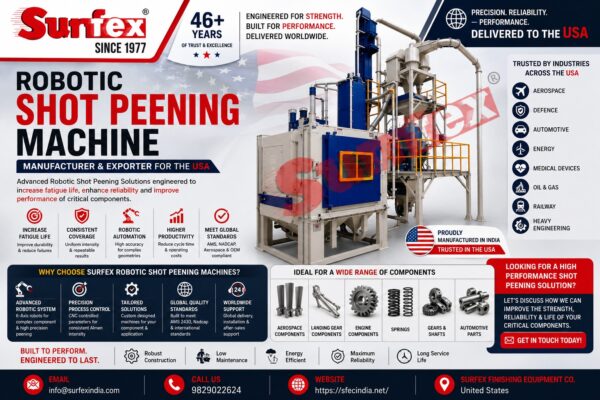
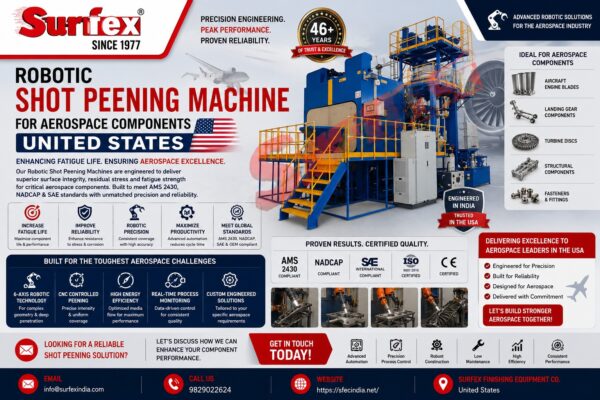
The Same Process, Delivered With Zero Operator Variability
A robotic shot peening machine replaces the hand-held nozzle with a 6-axis industrial robot that runs a programmed toolpath — holding nozzle angle, standoff distance, and dwell time within microns on every single cycle. For US aerospace, defense, and precision automotive manufacturers, this is what turns a drawing note calling for AMS2432 or MIL-S-13165 controlled shot peening into a process you can actually certify and repeat, run after run, without depending on operator skill.
Robotic cells also reach zones a fixed nozzle cannot: internal bores, blade root fillets, and threaded sections, using rotary lances and multi-tool changeover heads mounted directly on the robot's wrist.
Six Reasons US Manufacturers Are Moving Away From Manual Peening Booths
Full, Verified Surface Coverage
Programmed toolpaths eliminate missed spots and overlap gaps common in hand-held peening, with saturation curves verified using Almen strips at every zone of the part.
Cycle-to-Cycle Repeatability
Nozzle standoff, impingement angle, and dwell time stay locked to the program, so part 1 and part 10,000 receive the same peening intensity.
Digital Process Records
Every cycle logs media flow, air pressure, robot speed, and Almen intensity — the paper trail aerospace and defense QA teams need at audit.
Access to Complex Geometries
Internal bores, fillet radii, blade roots, and threaded sections that a fixed nozzle cannot reach sit within a 6-axis robot's working envelope.
Higher Sustained Throughput
Dual-station turntables let one robot peen a new part while a finished part is unloaded, cutting idle time out of the cycle.
Closed-Loop Media Management
Integrated reclaim and screening keeps shot size and shape within spec, flagging media degradation before it affects intensity.
From Entry-Level Tumblast Units to Full Robotic Cells
Whatever stage your production line is at, there is a peening configuration built for your volume and specification.
Tumblast Type Shot Peening Machine
Compact, high-volume peening for small fasteners, clips, and bulk components using a rotating drum and blast wheel.
Multi-Nozzle Table Type Machine
Fixed nozzles arranged around a rotating table — suited to gears, flanges, and disc-shaped components in medium volume.
Hanger / Indexing Type Machine
Parts are hung on indexing fixtures and rotated through the peening zone — ideal for castings and irregular shapes.
CNC Shot Peening Machine
Programmable multi-axis nozzle motion with closed-loop pressure and flow control for drawing-specified Almen intensity.
6-Axis Robotic Shot Peening Cell
Full robotic arm control for complex 3D geometries, internal bores, and aerospace-grade certified processes.
Satellite Table Type Machine
Two work-holding stations share one blast zone so loading and peening happen without stopping the cycle.
Industries We Engineer Peening Systems For
Aerospace & Defense
Turbine blades, discs, compressor blades, landing gear struts, structural fittings, fasteners.
Automotive & Motorsport
Crankshafts, connecting rods, gears, torsion bars, valves, coil and leaf springs, axles.
Oil, Gas & Energy
Drill string and mud motor parts, wind turbine shafts, compressor parts, boiler tubes, fracking pump parts.
Marine & Heavy Engineering
Marine rudders, propeller shafts, pipelines, boat hull hardware, structural pins.
Medical & Implant Manufacturing
Orthopedic implants and surgical components needing contamination-free surface treatment.
Additive Manufacturing
WAAM and DED-built components requiring post-process fatigue treatment.
Rail & Transportation
Axles, wheels, suspension components, and structural fasteners under cyclic loading.
General Precision Manufacturing
Bicycle frames, hand tools, exhaust manifolds, hydraulic components.
Serving Manufacturing Hubs Across the United States
Demand for controlled and robotic shot peening equipment is concentrated where aerospace, automotive, and energy manufacturing are strongest. These are the regions we most frequently supply into.
Seattle, WA
Airframe & structural component manufacturing
Wichita, KS
General aviation & airframe fabrication
Hartford, CT
Jet engine & turbine component manufacturing
Detroit, MI
Crankshaft, gear & drivetrain component plants
Houston, TX
Drill string & downhole tool manufacturing
Tulsa, OK
Oilfield equipment & pump component fabrication
Los Angeles, CA
Aerospace & defense component suppliers
Phoenix, AZ
Turbine & avionics component manufacturing
Chicago, IL
Heavy machinery & structural component fabrication
Cleveland, OH
Precision metal component manufacturing
Indianapolis, IN
Engine & turbine component manufacturing
Charlotte, NC
Energy & industrial component fabrication
Typical Parts Treated on Shot Peening & Robotic Peening Lines
- Turbine blades & discs
- Landing gear struts
- Compressor blades
- Crankshafts
- Connecting rods
- Gears & gear teeth
- Coil springs
- Leaf springs
- Torsion bars
- Valves
- Axles
- Drill bits
- Mud motor components
- Boiler tubes
- Marine rudders
- Propeller shafts
- Cylinder bores (ID peening)
- Fasteners & bolts
- Exhaust manifolds
- WAAM / DED printed parts
What Goes Into Every Robotic Shot Peening Cell We Build
Multi-Axis Industrial Robot
6-axis articulated arm paired with a 7th-axis rotary or linear track for large or long components.
PLC-Controlled Parameters
Closed-loop control of air pressure, media flow, nozzle standoff, and traverse speed with recipe storage per part number.
Dual-Station Turntable
Continuous-cycle design — one station peens while the other is loaded or unloaded.
Almen Strip Verification
Integrated or offline Almen fixture confirming saturation curve per AMS2430 / AMS2432 procedures.
Media Reclaim & Classification
Cyclone separation and screening remove broken or oversize media before it re-enters the nozzle.
Dust & Noise Containment
Fully enclosed cabinet with pulse-jet dust collection built to meet US workplace air-quality requirements.
Media Selection Matters as Much as the Machine
Cast Steel Shot
The standard choice for high-intensity peening of steel components such as crankshafts, gears, and springs.
Stainless Steel Shot
Used where iron contamination cannot be tolerated on the finished surface, common in aerospace applications.
Glass Bead & Ceramic Media
Selected for lighter, controlled intensities on thin-walled or delicate aerospace components.
Shot Peening & Robotic Peening, Step by Step
Fixture & Program Load
The part is clamped into a dedicated fixture and the machine pulls up the stored recipe for that part number.
Almen Strip Calibration
An Almen strip is peened and measured to confirm the process produces the specified arc height and intensity.
Peening Pass
The nozzle or robot executes the programmed path across every critical zone, maintaining consistent angle and dwell time.
In-Process Media Monitoring
Media is continuously reclaimed, screened, and topped up to stay within the qualified range for the run.
Data Logging & Release
Process parameters are logged against the part serial number, generating the certification record your QA system requires.
Where Robotic Shot Peening Outperforms Manual Cabinets
| Parameter | Manual / Hand-Held Peening | Robotic Shot Peening |
|---|---|---|
| Coverage consistency | Operator-dependent, variable | Programmed, repeatable within microns |
| Almen intensity control | Manual spot checks | Continuous closed-loop monitoring |
| Access to internal bores / fillets | Limited by nozzle reach | Full 6-axis reach into complex geometry |
| Process documentation | Manual log sheets | Automated digital traceability per serial number |
| Cycle time on batch runs | Slower, operator fatigue factor | Sustained throughput, dual-station cycling |
| AMS2432 / MIL-S-13165 compliance | Difficult to demonstrate consistently | Built for audit-ready compliance |
Compliance Built Into the Machine, Not Bolted On Afterward
Engineering Support From Drawing to Production Sign-Off
Every shot peening and robotic shot peening machine we build is engineered around your part drawing, target Almen intensity, and production volume — not sold off a fixed catalog spec sheet. Our team reviews your fatigue-critical zones, recommends media type and intensity range, and configures the toolpath before the machine is built.
Documentation, Almen calibration procedures, and operator training are provided with every machine, along with ongoing technical support as new part numbers are added to your line.
View Certifications & AffiliationsShot Peening & Robotic Shot Peening — Common Questions From US Buyers
Shot blasting is a surface-cleaning process that removes scale, rust, or coatings, while shot peening is a controlled cold-working process that induces compressive residual stress to improve fatigue life. Peening uses controlled shot size, pressure, and Almen intensity, whereas blasting is optimized purely for cleaning speed.
A robotic system holds nozzle angle, standoff distance, and dwell time to a programmed path on every cycle, removing operator-to-operator variation. This matters most on aerospace, defense, and automotive parts where inconsistent coverage can lead to premature fatigue failure or a failed quality audit.
Yes. Our controlled and robotic peening machines are engineered with closed-loop control of air pressure, media flow, and traverse speed, along with an integrated Almen strip verification station, so the process can be qualified and documented against AMS2432 and related specifications.
Common applications include turbine blades and discs, landing gear struts, crankshafts, connecting rods, gears, torsion bars, valves, coil and leaf springs, drill string and mud motor components, marine rudders, and additively manufactured (WAAM/DED) parts.
Peening intensity is verified using Almen test strips (A, N, or C type) that are peened alongside production parts. The arc height of the strip is measured and plotted on a saturation curve to confirm the process delivers the specified intensity range.
Cast steel shot is the standard choice for high-intensity peening of steel parts. Stainless steel shot is used where iron contamination must be avoided, and glass bead or ceramic media is used for lighter intensities on thin-walled or delicate components.
Yes. Robotic cells can be fitted with extended lances and rotary nozzles specifically for internal bore and internal diameter (ID) peening on parts such as cylinder bores, tubes, and complex cast or forged housings.
Yes, we design, manufacture, and export shot peening and robotic shot peening machines to manufacturers across the United States, engineered around each customer's part geometry, production volume, and applicable specification.
Lead time depends on machine configuration, fixture design, and any customization for part geometry. Once the part drawing and target Almen intensity are reviewed, our team provides a firm engineering and delivery timeline as part of the quotation.
The fastest way is to message us directly on WhatsApp with your part drawing or requirement, or submit the contact form on this page. Our engineering team responds with the right machine configuration and pricing based on your specification.
Get a Shot Peening or Robotic Shot Peening Machine Engineered Around Your Part
Send us your drawing, target Almen intensity, and production volume, and our team will size the right machine — manual, CNC, or fully robotic — for your application.